When I first started testing APIs, I spent hours manually sending requests, checking responses, and copy-pasting the same tests repeatedly. It was mind-numbing work, and I knew there had to be a better way.
That’s when I discovered API automation testing tools.
What is an API?
An API (Application Programming Interface) is like a bridge that lets two software systems communicate and share data. Instead of rebuilding features, developers use APIs to access existing services quickly and safely, kind of like telling a waiter about your order and getting what you need without ever stepping into the kitchen.
What Are API Automation Testing Tools?
API testing tools are purpose-built platforms that help developers and testers verify whether an API behaves the way it should. With these tools, you can quickly create, run, and automate tests to check everything from basic functionality to performance and security, without manually sending request after request.
Modern API testing tools go beyond simple request–response checks. Many offer scripting support, environment switching (e.g., dev, QA, and staging), and seamless CI/CD integration, so your tests run automatically every time code is pushed.
Even free or open-source tools can be surprisingly powerful. They typically offer essentials like sending API calls, validating responses, automating test execution, and generating quick reports, which makes them perfect for smaller teams or anyone just starting with API automation.
So, I decided to put together this guide based on what I’ve used and what I’ve seen work (and not work) for different teams. We’re going to look at 10 solid options, and I’ll tell you straight up what’s good, what’s annoying, and who each tool is really meant for.
Sound good? Let’s jump in.
Why are API automation tools important?
Here’s the thing: APIs are everywhere. They connect your front end to the back end, link different services, and make everything talk to each other. When one breaks, it’s a domino effect.
In 2025, API automation testing tools will be essential because API failures cause up to 70% of modern outages.
Manual testing means you’re sitting there sending the same requests again, checking 50, maybe 100, endpoints every time something changes. It’s exhausting, and humans make mistakes, especially when doing boring, repetitive work.
Automation fixes this. Write the test once, and it runs perfectly every time. Hook it up to your CI/CD pipeline, and bugs get caught before production. Your Fridays get a lot less stressful.
Alright, let’s look at the tools.
Best 10 API Automation Testing Tools
1. Postman
Postman is basically the Swiss Army knife of API testing. If you’ve done any API work at all, you’ve probably heard of it. It started as this simple Chrome extension for sending API requests, and now it’s become this whole platform that teams use for everything from testing to documentation.
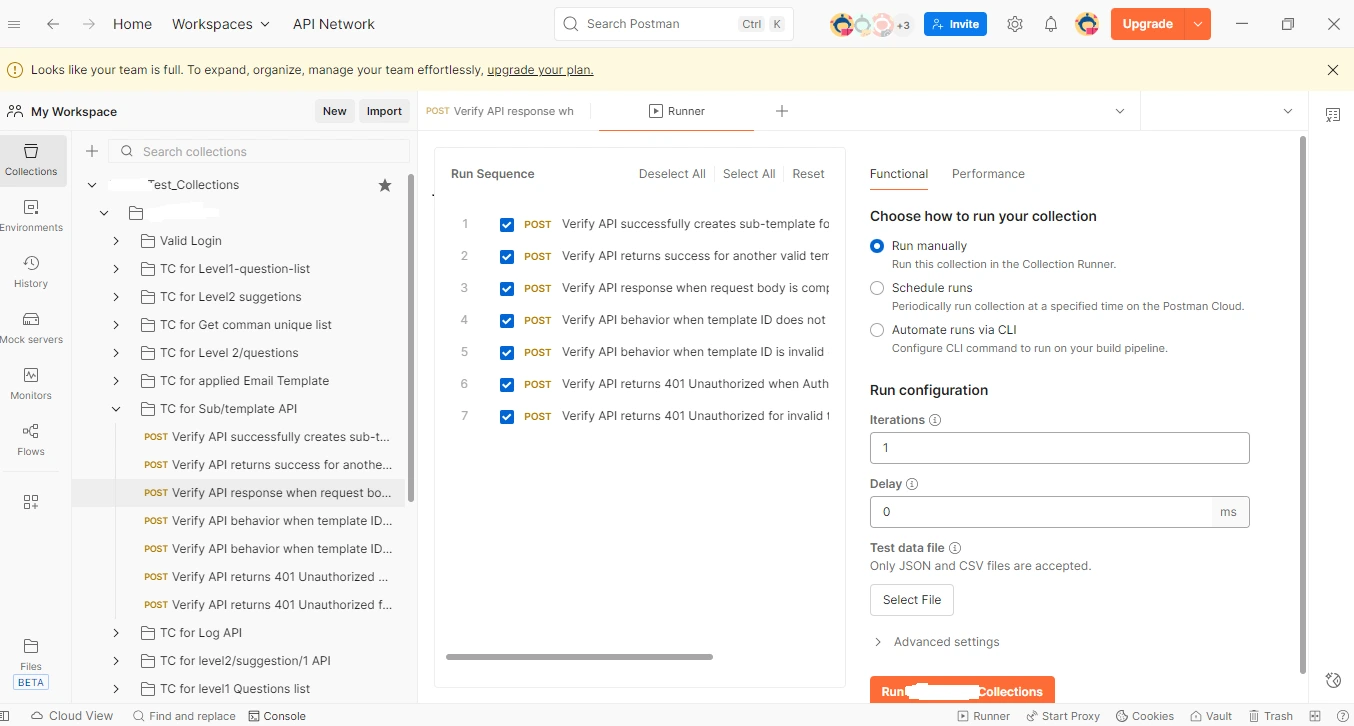
Key Features:
- Super easy interface for building and organizing requests
- Collections that let you group related tests together
- Environment variables so you’re not hardcoding everything
- JavaScript for writing test scripts
- Newman, their CLI tool that lets you run tests in your pipeline
Best For:
Honestly? Almost everyone. If you’re new to API testing, start here. If you’re on a team that has a mix of technical and non-technical folks, this is your safest bet.
Pros:
- It’s SO easy to pick up. Like, you’ll be writing tests within an hour.
- Huge community. Whatever problem you run into, someone’s already solved it.
- Works great for both quick manual tests and full automation
- Cloud sync means your whole team can access the same collections
- The free version is generous
Cons:
- Once your team grows, the pricing can get steep fast
- Everything’s GUI-based, which some developers find limiting
- Version control for collections isn’t great
Pricing:
Free to start. Paid plans kick in at $12 per person per month.
3. Requestly
Requestly is a lightweight, open-source platform designed for API mocking, debugging, and client testing. It’s especially useful when you need to intercept, modify, or mock HTTP(S) requests before or during automation.
Key Features:
- API client + collections + environments for building and testing requests.
- HTTP request interception and modification: redirects, header/body changes, and delay simulation.
- API mocking: create mock endpoints, simulate network latency, and override responses and status codes.
- Supports GraphQL and REST endpoints, local-first workspaces, and integrates with version control.
Best For:
Teams (especially frontend, QA, and integration engineers) who need fast mock-oriented or intercept-capable workflows, e.g., when the backend is unstable or unavailable, or when you need to debug complex request/response behaviors.
Pros:
- Very fast setup and browser-friendly
- Excellent for mocking and intercepting traffic
- Local-first and open-source friendly
Cons:
- Less tailored for full-scale functional API automation compared to heavy libraries
- Primarily designed for debugging/mock workflows rather than large test suites
- Requires a Chrome extension or desktop app for full capabilities
Pricing:
Free version with open-source core; commercial features available.
3. REST Assured
REST Assured is basically a library that lets you write API tests in Java, and it’s designed to feel really natural if you’re already comfortable with the language. Think of it as the developer’s API testing tool.
Key Features:
- Really readable syntax that almost looks like plain English
- Fits right in with BDD/TDD workflows
- Handles JSON and XML parsing without making you cry
- Authentication support built-in (OAuth, Basic Auth, all that stuff)
- Works perfectly with TestNG and JUnit
- XPath and JsonPath for digging into responses
Best For:
If your team writes Java, this is probably your answer. Also, great if you’re the kind of person who’d rather write code than click through a GUI.
Pros:
- The test code makes sense when you read it later
- Fits right into your existing Java projects
- Really good at complex validations
- It’s free. Completely open source.
- You can do pretty much anything you need
Cons:
- You need to know about Java.
- If your QA team isn’t technical, this won’t work
- No pretty GUI to click around in
- Not great for just poking around and exploring APIs
Pricing:
Free. Zero dollars.
4. Karate DSL
Karate is one of those tools that makes you go, “Wait, why didn’t anyone think of this before?” It combines API testing, performance testing, and even UI testing into one framework. The cool part? The syntax is so simple that even non-programmers can read and understand it.
Key Features:
- Tests that read like plain English
- Runs tests in parallel right out of the box
- You don’t need to know Java, even though it runs on the JVM
- Does API, performance, AND UI testing
- Solid assertion engine that handles complex scenarios
- Generates HTML reports automatically
Best For:
Teams that want one tool to rule them all, BDD enthusiasts, or anyone who needs both API and UI testing but doesn’t want to juggle multiple frameworks.
Pros:
- Very readable test syntax
- No external dependencies needed
- Excellent documentation and examples
- Can handle complex scenarios easily
- Free and open source
- Active community support
Cons:
- Runs on JVM (requires Java installation)
- IDE support could be better
- Learning the DSL syntax takes time
- Limited integrations compared to established tools
Pricing:
Free. Open source.
5. SoapUI
SoapUI has been around for years and is a comprehensive tool for testing both SOAP and REST APIs. It’s particularly strong in enterprise environments where SOAP services are still common.
Key Features:
- Support for both SOAP and REST protocols
- Graphical interface for creating tests
- Data-driven testing capabilities
- Security testing features
- Load testing functionality (in Pro version)
- Extensive assertion library
- WSDL/Swagger import
Best For:
Enterprise teams, projects with SOAP services, and organizations need comprehensive API testing features.
Pros:
- Handles SOAP and REST equally well
- Robust security testing features
- Good for complex enterprise scenarios
- Open-source version available
- Mature tool with proven track record
Cons:
- The interface feels outdated
- Can be resource-heavy
- Steeper learning curve
- Best features locked behind paid version
- Slower than modern alternatives
Pricing:
Free (open source). SoapUI Pro starts at $659/year.
Need help choosing the right tool or setting up API automation?
Our QA specialists can guide you.
6. Playwright
While Playwright is primarily known for browser automation, it also offers excellent API testing capabilities. It’s a modern, fast, and reliable tool built by Microsoft.
If you’re comparing Playwright with other popular UI/API automation tools, you might find it useful to understand how it stacks up against Selenium, especially in terms of speed, reliability, and cross-browser coverage.
Key Features:
- Native API testing support
- Works with JavaScript, TypeScript, Python, Java, and .NET
- Built-ins retry logic and wait mechanisms
- Excellent debugging tools
- Parallel test execution
- Can combine API and UI tests
- Great reporting and tracing
Best For:
Teams already using Playwright for UI testing, projects needing both API and UI automation, and modern JavaScript/TypeScript projects.
Pros:
- Fast and reliable
- Modern architecture and active development
- Excellent documentation
- Free and open source
- Multi-language support
- Great developer experience
Cons:
- Relatively new for API testing
- Smaller community compared to Postman
- Requires programming knowledge
- Not as feature-rich as dedicated API tools
Pricing:
Free (open source)
7. Cypress
Like Playwright, Cypress is primarily an end-to-end testing tool for web applications, but it also supports API testing through its cy.request() command and intercept capabilities.
Key Features:
- Simple API for making HTTP requests
- Request/response interception
- Time-travel debugging
- Automatic waiting and retries
- Real-time reloading
- Screenshots and video recording
- Dashboard service for test analytics
Best For:
Frontend teams, projects already using Cypress for UI testing, and JavaScript/TypeScript developers.
Pros:
- Extremely easy to set up and use
- Great developer experience
- Excellent documentation and community
- Real-time test execution viewing
- Free open-source version
Cons:
- Limited to JavaScript/TypeScript
- API testing features are secondary
- Not as comprehensive as dedicated API tools
- Dashboard can be expensive
- Single browser tab limitation
Pricing:
Free (open source). The dashboard starts at $75/month for teams.
8. Insomnia
Insomnia is a clean, modern API client focused on GraphQL and REST APIs. It’s often compared to Postman but with a more streamlined interface and better GraphQL support.
Key Features:
- Beautiful, intuitive interface
- Excellent GraphQL support with schema introspection
- Environment and variable management
- Code snippet generation for multiple languages
- Plugin system for extensibility
- Git sync for version control
- gRPC support
Best For:
Teams working with GraphQL, developers who prefer a cleaner interface than Postman, and projects needing strong version control.
Pros:
- Clean and modern UI
- Best-in-class GraphQL support
- Open-source core
- Good plugin ecosystem
- More affordable than Postman
- Native Git integration
Cons:
- Smaller community than Postman
- Fewer collaboration features
- CLI automation is less mature
- Limited learning resources
Pricing:
Free for individual use. Team plans start at $5/user/month.
9. Apache JMeter
JMeter is primarily known as a performance testing tool, but it’s also capable of functional API testing. It’s a powerful, open-source tool that’s been around since 1998.
Key Features:
- Load and performance testing capabilities
- Support for multiple protocols (HTTP, SOAP, REST, FTP, etc.)
- Distributed testing for large-scale load tests
- Extensive reporting and graphing
- Plugin ecosystem for extended functionality
- Record and playback features
Best For:
Performance testing, load testing scenarios, and teams need both functional and non-functional testing.
Pros:
- Powerful performance testing features
- Completely free and open source
- Large plugin ecosystem
- Can test various protocols
- Good for stress testing
Cons:
- Outdated interface
- Not designed primarily for functional testing
- Steep learning curve
- Resource-intensive
- Better alternatives exist for pure API testing
Pricing:
Free (open source)
10. Thunder Client
Thunder Client is a lightweight REST API client extension for Visual Studio Code. It brings API testing directly into your IDE, eliminating the need to switch between applications.
Key Features:
- Native VS Code integration
- Lightweight and fast
- Collections and environment support
- Scriptless testing (GUI-based)
- Local storage (no cloud dependency)
- Git-friendly file format
- CLI support for CI/CD
Best For:
VS Code users, developers who want API testing in their IDE, and small- to medium-sized projects.
Pros:
- No application switching needed
- Very fast and lightweight
- Works offline by default
- Simple and intuitive
- Affordable pricing
- Git-friendly
Cons:
- Limited to VS Code users
- Fewer features than full API platforms
- Smaller community
- Basic collaboration features
- Not suitable for complex enterprise needs
Pricing:
Free for personal use. Pro version at $5/month.
Note: Baseline11 is our cloud-native API load and performance testing platform built to help teams simulate real-world traffic and validate scalability with ease. It’s designed specifically for load, stress, and performance testing, not functional API automation.
Quick Comparison Table for API Testing Tools
|
Tool |
Best For |
Code or No Code |
Free Option |
Unique Pros |
Major Cons |
|
Postman |
Mixed skill teams, beginners |
Low |
Yes |
Easy, huge community |
Pricey at scale, GUI only |
|
Requestly |
The frontend team, QA engineers and developers |
No-code |
Yes |
Fast request interception, powerful mocking, browser-friendly |
Not suited for full-scale API automation; requires extension/app |
|
REST Assured |
Java coders, enterprise testers |
Code |
Yes |
Powerful, flexible |
Java-only, no GUI |
|
Karate DSL |
BDD fans, mixed testing (API/UI/load) |
Both> |
Yes |
All-in-one testing |
JVM only, learning curve |
|
SoapUI |
Enterprises (SOAP), heavy data-driven tests |
Low |
Yes |
Handles SOAP & REST |
Heavy, some features paid |
|
Playwright |
Modern JS/TS projects + UI testers |
Code |
Yes |
Fast, open source> |
New for APIs, code needed |
|
Cypress |
Frontend devs, JS/TS teams |
Code |
Yes |
Great UX, auto-reload |
Browser limit, API is secondary> |
|
Insomnia |
GraphQL, REST devs |
Low |
Yes |
Clean UI, Git sync> |
Less popular, CLI limited |
|
JMeter |
Performance testing, legacy automation |
Code |
Yes |
Load, multi-protocol |
Outdated, steep curve |
|
Thunder Client |
VS Code users, lightweight devs |
Low |
Yes |
No switching, offline |
VSCode only, basic features |
How We Evaluated These Tools
To keep this list fair and useful, we evaluated all tools using the same core criteria:
Language Support: Whether the tool works across multiple languages or is platform-specific.
Ease of Scripting: How simple it is to write, maintain, and scale tests (code-based or scriptless).
Assertions: Strength of validation options for status codes, payloads, schemas, and complex APIs.
Reporting: Availability of clear, actionable test reports, logs, and debugging insights.
CI/CD Integration: How easily the tool fits into pipelines like GitHub Actions, GitLab, Jenkins, and Bitbucket.
Mock Server Support: Ability to simulate APIs for early or isolated testing.
Performance Capabilities: Whether the tool supports load, stress, or concurrency testing.
Cost: Free tier availability and overall budget-friendliness for teams.
How to Choose the Right API Automation Testing Tool for Your Team
Use this quick decision guide to pick the best API automation tool:
1. Team Skill Level
- Non-technical or mixed teams: Postman, Insomnia, Thunder Client
- Developer-heavy teams: REST Assured, Playwright, Karate DSL
2. Tech Stack Fit
- Java projects: REST Assured
- JavaScript/TypeScript: Playwright, Cypress
- GraphQL APIs: Insomnia
- SOAP services: SoapUI
3. Budget
- No budget: REST Assured, Karate DSL, Playwright, Cypress (free tier), JMeter
- Low budget: Thunder Client, Insomnia
- Enterprise budget: Postman Pro, SoapUI Pro
4. Integration Needs
- Strong CI/CD support: Postman (Newman), REST Assured, Karate DSL, Playwright
- Team collaboration: Postman, Insomnia
- Version control: REST Assured, Karate, Playwright, Insomnia
5. Performance Testing
- Load/performance testing: JMeter, Karate
- Functional-only testing: Postman, Playwright, Cypress, Thunder Client, Insomnia
Best Practices for API Automation Testing
Follow these essentials to get the most value from your API automation:
Start with Smoke Tests
Run a small, critical test set early and often catch major issues fast.
Use Environment Variables
Avoid hardcoding URLs, credentials, or keys; keep tests portable and secure.
Manage Test Data Smartly
Use dynamic data, reset states, and avoid test dependencies.
Write Strong Assertions
Validate not just status codes, check schemas, fields, and business logic.
Handle Authentication Securely
Use tokens safely, refresh them properly, and never commit secrets to Git.
Organize Tests Clearly
Group them by feature, use meaningful names, and keep the structure consistent.
Integrate CI/CD Early
Add your tests to pipelines from the start to ensure continuous quality.
Optimize Test Performance
Keep tests fast and efficient so they always run in CI.
Maintain the Suite
Review regularly, remove obsolete tests, and refactor duplicates.
Use Reporting
Use reports to spot failures, flaky tests, and quality trends.
Common API Automation Testing Mistakes to Avoid
Even with the right tools, a few common mistakes can hold your API automation back.
Over-Testing
Don’t try to automate everything. Focus on critical paths and high-risk areas first.
Ignoring Negative Scenarios
Always test error conditions, invalid inputs, and edge cases, not just the happy path.
Poor Error Messages
When a test fails, the error message should clearly indicate what went wrong and where.
Not Reviewing Failed Tests
Failed tests aren’t just noise. Investigate every failure to understand whether it’s a real bug or a flaky test.
Using UI Tests When API Tests Would Suffice
API tests are faster and more reliable. Only use UI tests when you need to verify the user interface itself.
Conclusion
Choosing the right API automation tool isn’t about picking up the flashiest option; it’s about finding the one that fits your team’s skills, tech stack, and workflow. Whether you prefer code-based frameworks or intuitive GUI tools, the goal is the same: faster feedback, fewer production surprises, and more confidence in every release.
Start small, automate what matters most, and build on a solid foundation. And if your team needs help setting up the right strategy or scaling efficiently, partnering with our API testing experts can make the journey smoother.
At the end of the day, the best tool is the one that helps your team ship quality consistently and confidently.
FAQs
1. Is Postman good for API automation?
Yes. Postman is one of the most beginner-friendly tools for API automation. It supports scripting with JavaScript, environment variables, reusable collections, and automation via Newman in CI/CD pipelines.
2. Which tool is best for API testing?
The best API testing tools are Baseline11, Postman, REST Assured, Playwright, and Karate DSL. The right choice depends on your team’s skills; GUI users prefer Postman, while developers lean toward REST Assured or Playwright.
3. Do I need coding for API automation?
Not always. Tools like Postman, Insomnia, and Thunder Client require little to no coding. However, advanced automation using REST Assured, Playwright, or Karate DSL does benefit from programming skills.
4. Can Playwright do API testing?
Yes. Playwright supports full API testing, including sending requests, validating responses, mocking APIs, and combining API + UI tests in the same suite. It’s especially powerful for JavaScript and TypeScript teams.
5. Who is REST Assured best suited for?
REST Assured is best suited for Java developers who want code-based API automation. It integrates smoothly with JUnit, TestNG, Maven, and CI/CD pipelines, making it ideal for enterprise-level API testing.
6. Which API tool is easy to learn?
Postman, Insomnia, and Thunder Client are the easiest API tools to learn. They offer intuitive interfaces, scriptless workflows, and quick setup, perfect for beginners or manual testers transitioning into automation.