


Building a startup is all about speed, focus, and smart use of resources. While product innovation often gets the spotlight, software quality determines whether users stay or leave.
For many startups, maintaining an in-house QA team is expensive, time-consuming, and difficult to scale. That’s why QA outsourcing startups have become a strategic choice rather than just a cost-saving tactic.
From early-stage MVPs to fast-growing SaaS platforms, startups are outsourcing QA testing to improve product quality, accelerate releases, and stay competitive, without burning cash.
In this guide, we’ll break down why startups outsource QA, the real challenges involved, and how to choose the right QA outsourcing partner to support long-term growth.
Why QA Outsourcing Makes Sense for Startups
Startups operate under tight timelines, limited budgets, and constant product changes. QA outsourcing aligns perfectly with these realities.
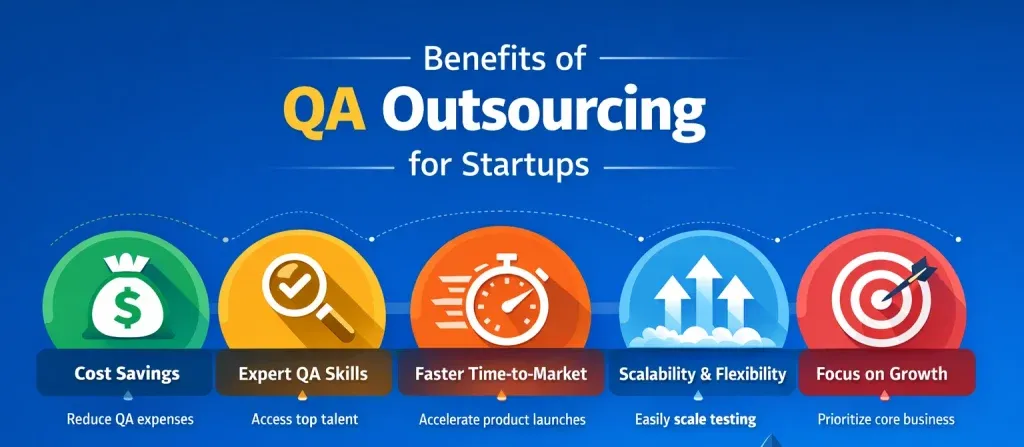
1. Reduced Costs Without Compromising Quality
Hiring an in-house QA team involves:
- Salaries & benefits
- Training & onboarding
- Testing tools & infrastructure
Outsourced QA eliminates these overheads. Startups pay only for the testing services they need, when they need them, making it a cost-effective alternative to in-house QA.
Many startups reduce QA-related costs by 30–50% through outsourcing, especially during early growth stages.
For cost-conscious startups, working with offshore QA teams, particularly in India has become a common approach due to access to skilled testers and flexible engagement models.
2. Access to Specialized QA Expertise
QA outsourcing companies employ testers skilled in:
- Manual & exploratory testing
- Automation testing
- Performance & load testing
- Security & compliance testing
Instead of training internal resources, startups instantly gain access to experienced QA engineers who understand industry’s best practices and real-world failure scenarios.
3. Faster Time-to-Market
Speed is critical for startups. Outsourced QA teams:
- Run parallel testing with development
- Use automation to shorten regression cycles
- Identify issues early before they reach production
This helps startups release features faster while maintaining stability, a key advantage in competitive markets.
4. Scalability as Your Startup Grows
Testing needs fluctuate:
- MVP phase → minimal testing
- Growth phase → heavy regression & performance testing
- Peak traffic → scalability validation
QA outsourcing allows startups to scale testing efforts up or down without long-term commitments or hiring challenges.
5. Focus on Core Business Priorities
By outsourcing QA testing, startups can focus on:
- Product innovation
- User acquisition
- Fundraising & partnerships
QA becomes a managed process instead of a bottleneck.
benefits of qa outsourcing
Common Challenges in QA Outsourcing
While QA outsourcing offers strong benefits, startups must address these challenges proactively.
Some startups also find it helpful to compare outsourcing with building an internal QA team early on, especially when deciding how to balance speed, cost, and long-term ownership.
In many cases, startups explore IT staff augmentation as a middle ground between full QA outsourcing and building an in-house team. Instead of handing testing off entirely, staff augmentation allows startups to extend their internal team with experienced QA engineers on a flexible basis, maintaining control while avoiding long-term hiring commitments.
1. Communication Gaps
Time-zone differences and unclear documentation can slow progress.
Best practice:
Choose a QA partner with overlapping work hours, clear reporting, and tools like Jira, Slack, or Trello.
2. Data Security & IP Protection
Sharing application data with external teams requires strict safeguards.
Best practice:
Work with vendors that follow ISO 27001, GDPR, HIPAA, and enforce NDAs and secure access protocols.
3. Maintaining Quality Standards
Not all QA vendors deliver the same level of quality.
Best practice:
Define KPIs such as defect leakage rate, test coverage, and turnaround time before onboarding.
4. Integration With In-House Teams
QA should work as an extension of your development team.
Best practice:
Adopt Agile or DevOps workflows where outsourced QA participates in sprint planning and release cycles.
Need QA Without Slowing Down Your Startup?
Get access to skilled QA engineers who understand fast releases, limited budgets, and rapid iterations. Scale your testing efforts on demand and keep your product stable as you grow.
Best Practices for Successful QA Outsourcing
To get maximum value from QA outsourcing, startups should follow these proven practices:
Define Clear Testing Requirements
Document:
- Product scope
- Supported platforms
- Performance expectations
- Security requirements
Clear expectations prevent delays and rework.
Choose the Right Outsourcing Model
- Onshore QA: Best communication, higher cost
- Nearshore QA: Balanced collaboration and pricing
- Offshore QA: Highly cost-effective, widely used by startups
Most startups prefer offshore or hybrid QA models for flexibility and cost control.
In some cases, startups prefer a blended approach, where external QA engineers work closely with internal teams rather than fully outsourcing testing.
Start With a Pilot Project
A short trial engagement helps evaluate:
- Testing quality
- Reporting clarity
- Communication efficiency
This minimizes risk before scaling the partnership.
Key Trends Shaping QA Outsourcing in 2026
In 2026, QA outsourcing has evolved into a quality engineering function, not just testing support.
-
AI-Driven Testing: AI generates test cases, predicts risk areas, and enables self-healing automation, reducing maintenance effort.
-
Autonomous CI/CD Testing: QA is embedded into CI/CD pipelines with automated quality gates and continuous regression testing.
-
Shift-Left + Shift-Right QA: Testing starts early and continues in production using monitoring and synthetic testing.
-
Security-First QA: API security, compliance checks, and automated vulnerability testing are now standard.
-
Cloud-Native Testing: On-demand environments enable fast, scalable, and cost-efficient testing.
-
Real-World Validation: Crowd testing and synthetic users simulate real traffic and user behavior.
How to Choose the Right QA Outsourcing Partner for Your Startup
Not all QA vendors are startup friendly. Here’s what to evaluate:
1. Startup & Industry Experience
Look for partners who understand:
- MVP validation
- Rapid iterations
- Budget constraints
2. Technical Capabilities
Ensure they offer:
- Manual & automation testing
- Performance & load testing
- API & security testing
3. Value Over Cost
Cheapest ≠ best. A reliable QA partner reduces long-term costs by preventing:
- Production bugs
- User churn
- Reputation damage
4. Proven Track Record
Check:
- Case studies
- Client testimonials
- Third-party reviews (Clutch, GoodFirms)
Conclusion
For startups in 2026, QA outsourcing is a strategic advantage. It enables teams to ship faster, maintain high software quality, and scale confidently without the burden of building and managing a large in-house QA team.
By partnering with the right QA outsourcing provider, startups can reduce release risks, adapt quickly to change, and keep their focus where it matters most: building great products and growing the business.
As software complexity and user expectations continue to rise, QA outsourcing will remain a critical pillar for sustainable startup success.