


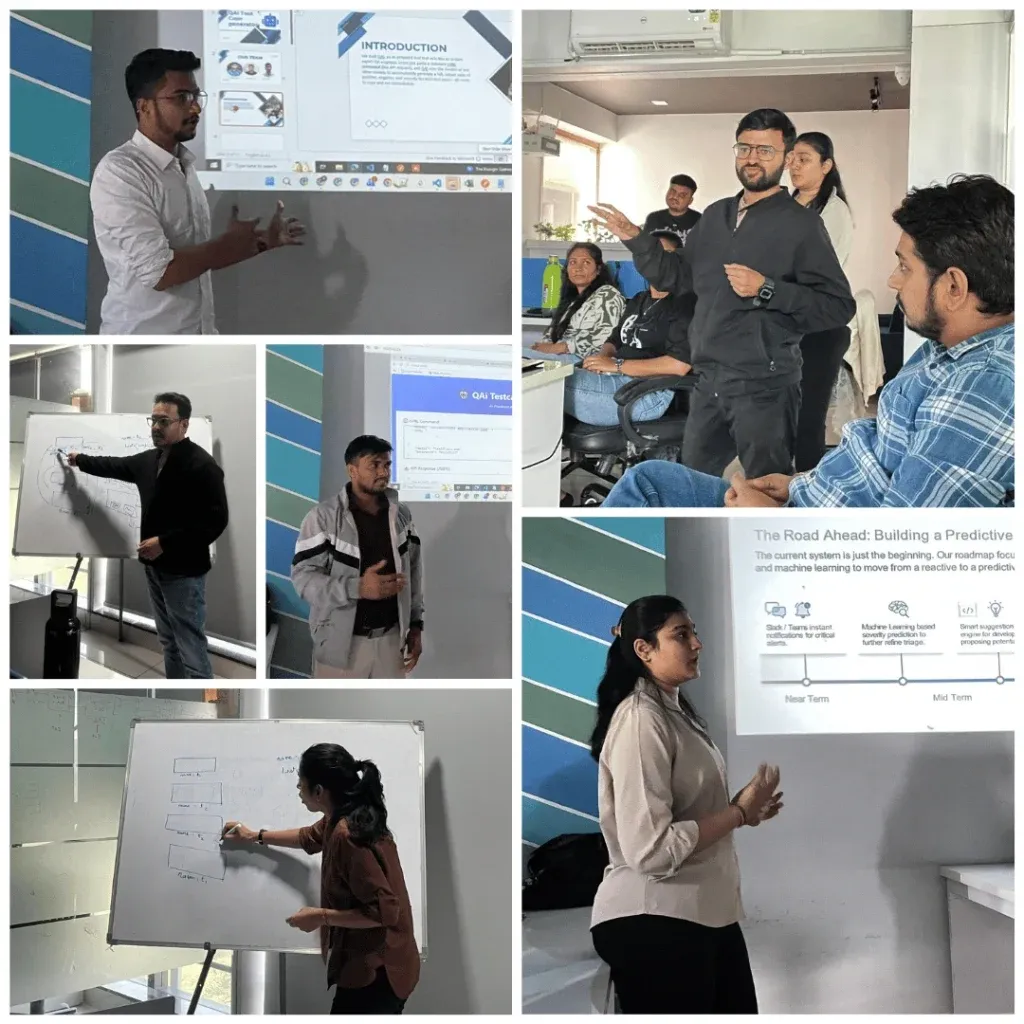
On 6th December 2025, PrimeQA achieved a major milestone by successfully hosting its first-ever Testnathon 1.0, a groundbreaking, idea-driven QA innovation event. This wasn't just another technical meetup; it was a powerful platform where teams presented research-based ideas to reshape the future of software testing through intelligent automation and AI-powered solutions.
Five highly motivated teams participated in the event, each delivering a unique perspective on how modern QA can evolve using automation, artificial intelligence, semantic analysis, and smart workflows. Instead of focusing purely on competitive coding, this Testnthon emphasized innovation, research, and real-world problem-solving.
Here's a detailed look at the five breakthrough ideas that stole the spotlight at PrimeQA Testnthon 1.0.
Event Glimpses:
1. AI-Powered Self-Healing Test Automation
The first presentation focused on one of the most critical challenges faced in automation today, test script failures caused by UI changes. The team introduced the concept of AI-Powered Self-Healing Test Automation, an intelligent mechanism where automation scripts automatically adapt to changes in the application interface without manual intervention.
Key Highlights:
- Smart element detection using AI
- Automated recovery from locator failures
- Reduced maintenance cost of automation suites
- Faster regression cycles
This solution aims to eliminate one of the biggest pain points in test automation, constant script maintenance. By introducing self-healing capabilities, QA teams can spend less time fixing scripts and more time improving test quality and coverage.
2. Chatbot Automation Testing – Botium + Semantic AI Testing Approach
The second team explored the rapidly growing domain of chatbot testing. Their presentation focused on combining Botium, a popular chatbot testing framework, with Semantic AI Testing to validate not just conversational flows but also intent accuracy and contextual understanding.
What Made This Idea Stand Out:
- Intent validation using semantic intelligence
- AI-driven chatbot response analysis
- Improved accuracy in conversational testing
- Support for multi-platform chatbot automation
With AI-powered chatbots becoming a core part of modern digital platforms, this approach ensures that bots don't just work technically but also communicate meaningfully and accurately with users.
3. Auto Cover – Smart Test Coverage Verifier
The third presentation introduced Auto Cover, a smart solution designed to help QA teams verify test coverage effectively and intelligently. One of the biggest testing challenges today is ensuring that all functional paths are properly tested, and this idea addresses that head-on.
Core Capabilities:
- Automated test coverage analysis
- Identification of untested business flows
- Risk-based test gap detection
- Reporting with actionable insights
Auto Cover focuses on eliminating blind spots in QA. It enables testing teams to validate whether their test suite truly covers the application's business-critical areas, leading to higher confidence in release stability.
4. QAi Test Case Generator
The fourth team introduced an innovative concept, QAi Test Case Generator, a solution designed to automatically generate intelligent, optimized, and high-quality test cases using AI.
Key Advantages:
- Automatic test case generation from requirements
- Reduced manual documentation effort
- Consistent test structure and coverage
- Faster test design cycles
This idea aims to transform one of the most time-consuming tasks in QA, test case creation, into a fast, consistent, and automated process. For both startups and enterprise QA teams, this concept promises huge productivity gains.
5. From Chaos to Clarity – Revolutionizing the QA Workflow with Intelligent Automation
The final presentation tied everything together with a powerful vision titled "From Chaos to Clarity" — focused on transforming fragmented testing processes into a streamlined, intelligent, and automated QA workflow.
The Vision Behind This Idea:
- Intelligent automation across the QA lifecycle
- Smarter test execution and reporting
- Predictive defect analysis
- Unified visibility of testing performance
This idea addressed a common enterprise problem: disconnected QA tools, scattered reports, and inefficient workflows. By unifying the entire QA process under intelligent automation, teams can achieve better speed, clarity, and reliability.
A Research-Driven Approach to QA Innovation
What made PrimeQA Testnthon 1.0 truly unique was its focus on research and ideas rather than just coding challenges. Each team approached testing problems through:
- Real-world QA bottlenecks
- Scalability challenges
- Automation inefficiencies
- AI adoption in testing
The discussions during the Q&A sessions were insightful, interactive, and highly engaging. The PrimeQA expert panel evaluated each idea based on:
- Innovation and originality
- Real-world applicability
- Technical depth
- Future scalability
Why PrimeQA Testnthon 1.0 Was a Major Success
- First-ever Testnthon by PrimeQA
- Idea-driven innovation platform
- Strong focus on AI, automation, and smart QA
- High engagement through Q&A sessions
- Research-oriented testing mindset
This Testnthon successfully created a collaborative environment where ideas, learning, and innovation came together, laying a strong foundation for future QA innovation events.
Looking Ahead: The Future of QA Innovation with PrimeQA
PrimeQA Testnthon 1.0 was just the beginning. The creativity, enthusiasm, and forward-thinking mindsets displayed during the event have set the benchmark for what the next generation of QA innovation will look like.
With rapid advancements in AI, automation, and intelligent testing, PrimeQA remains committed to building platforms that empower testers, engineers, and innovators to shape the future of software quality.